
EARLY SIGNS OF DEPARTURE
August has arrived with no let-up in the weather as the hot and dry conditions continue. Water levels have further dropped but such is the skill of the parent ospreys, Syfaddan and Clogwyn, sufficient fish supply continues to be brought in. Since chicks 0U0 and 0U1 fledged over a week ago, Clogwyn has excelled herself in becoming a significant 'breadwinner' in the family by supplementing fish deliveries to the nest. Between 30 July and 2 August alone she clocked up no less than 6 fine piscatorial meals for her young.
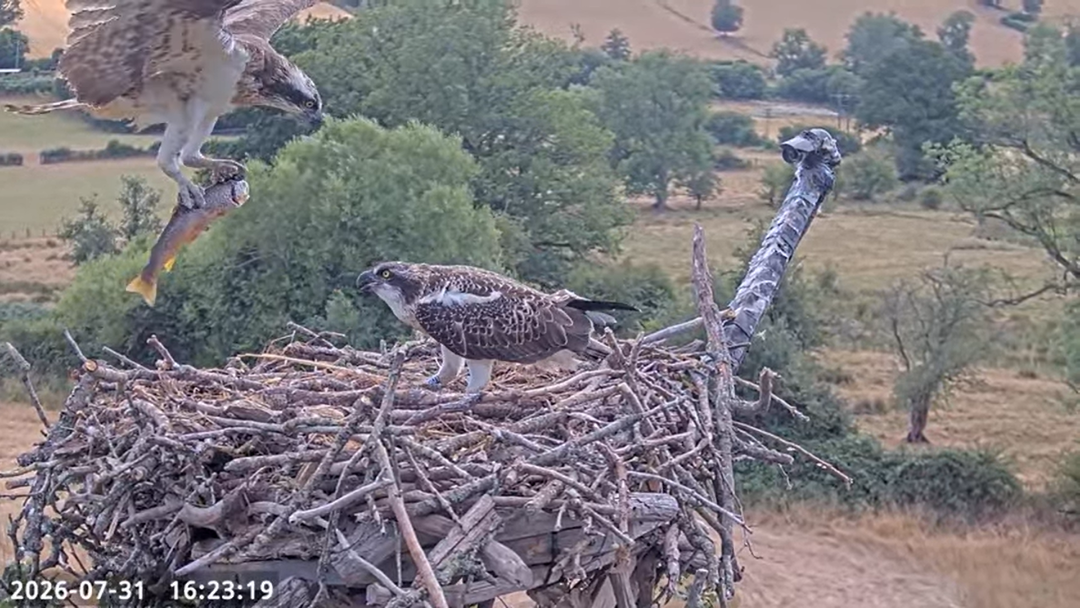
Clogwyn’s home delivery
These fish deliveries have been readily received with a certain amount of new-found greed and self-interest! Sibling rivalry over food has featured regularly in this week's observations, words like “tug-o-war” and “0U1 victorious” have peppered the reports.
Typical is the following: 31 July at 06.44: “Syfaddan delivers a large fish. 0U0 mantles and flies off with it”. “1 August 17.21 Entire fish delivered and 'fought over'. 0U1 wins the battle. Leaves the nest but returns with it. 0U0 still very hungry – Syfaddan answers the call by catching another fish”
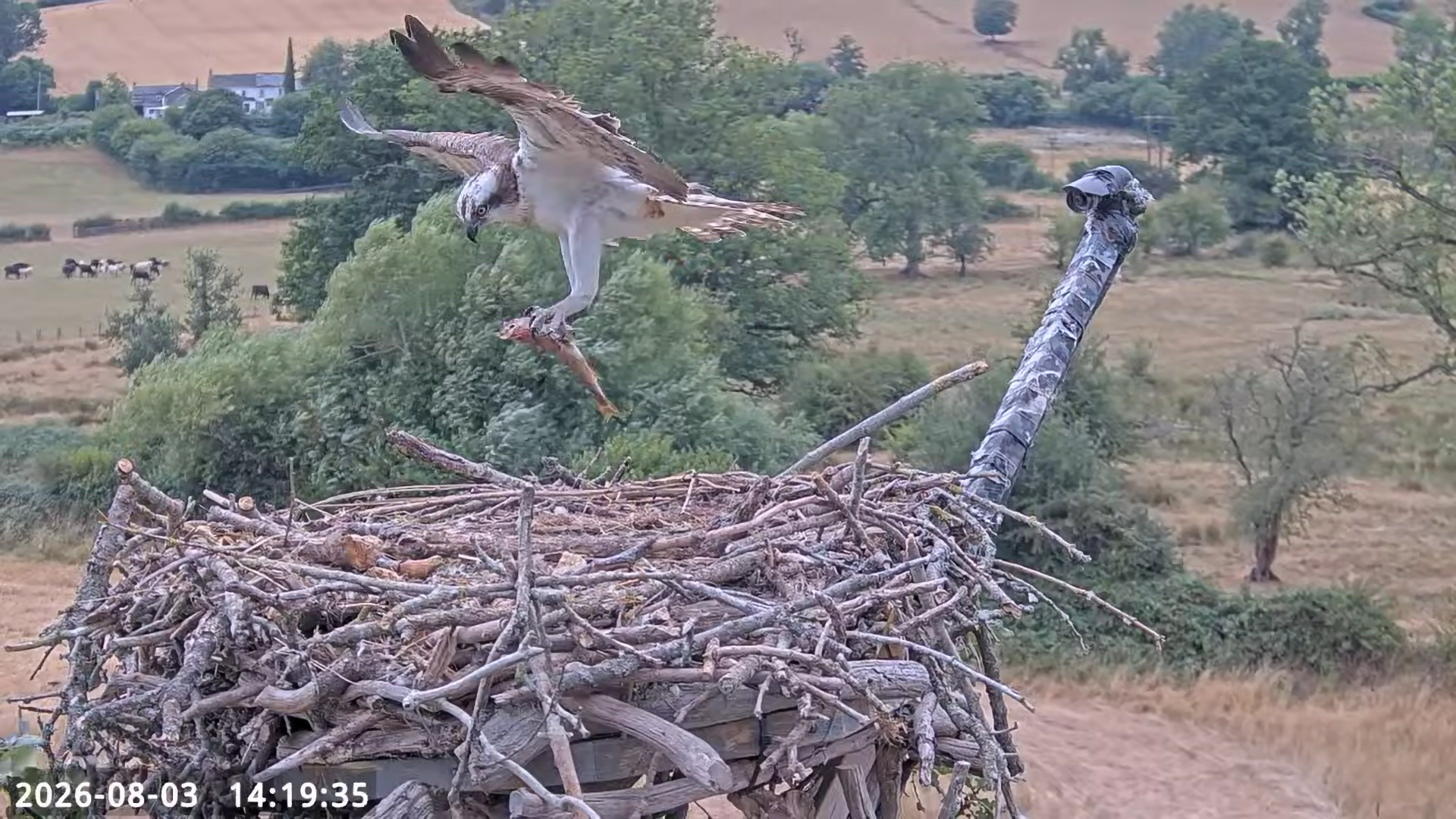
Syfaddan delivers to an empty nest….
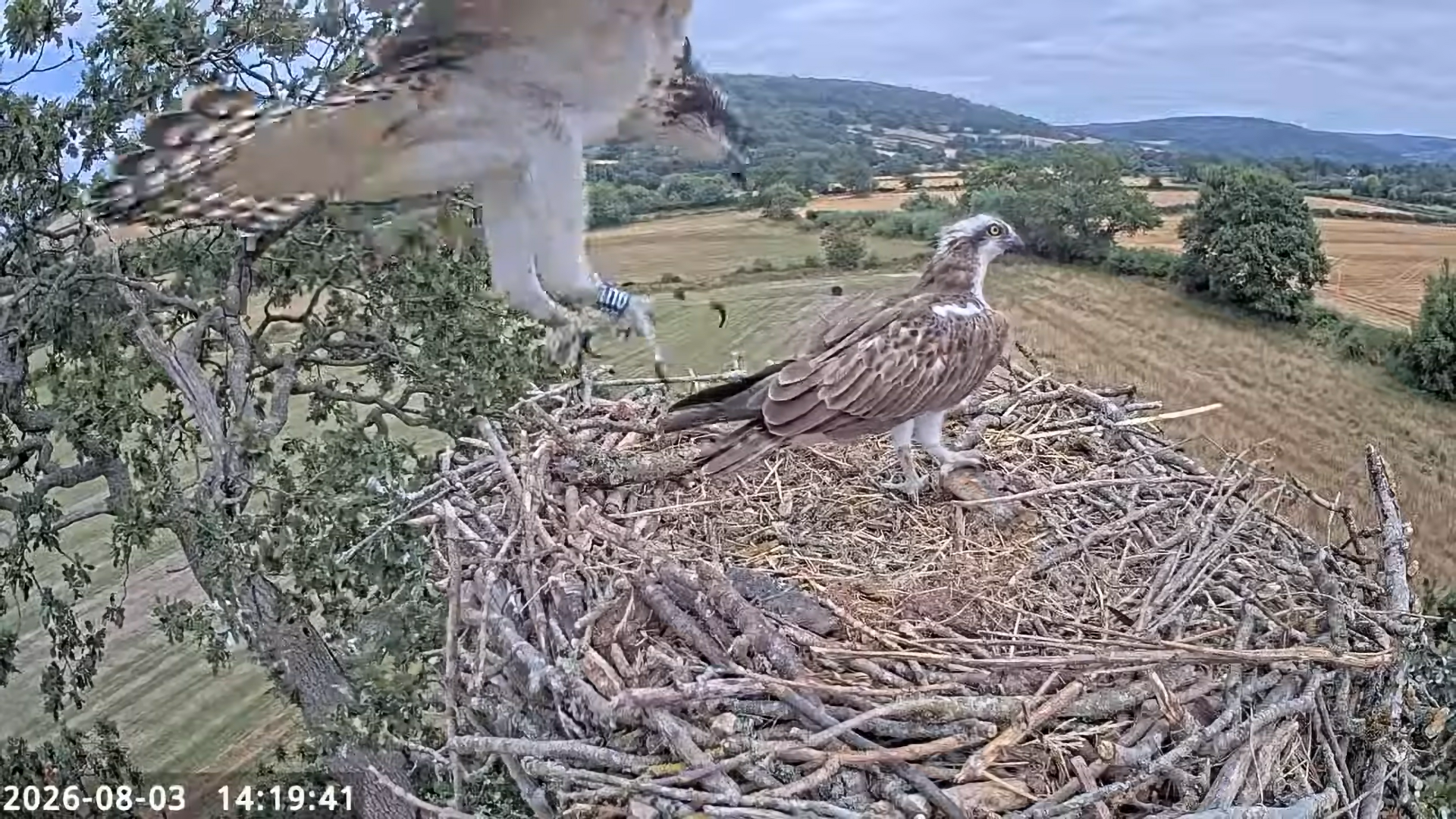
…… Six seconds later it is claimed by 0U1
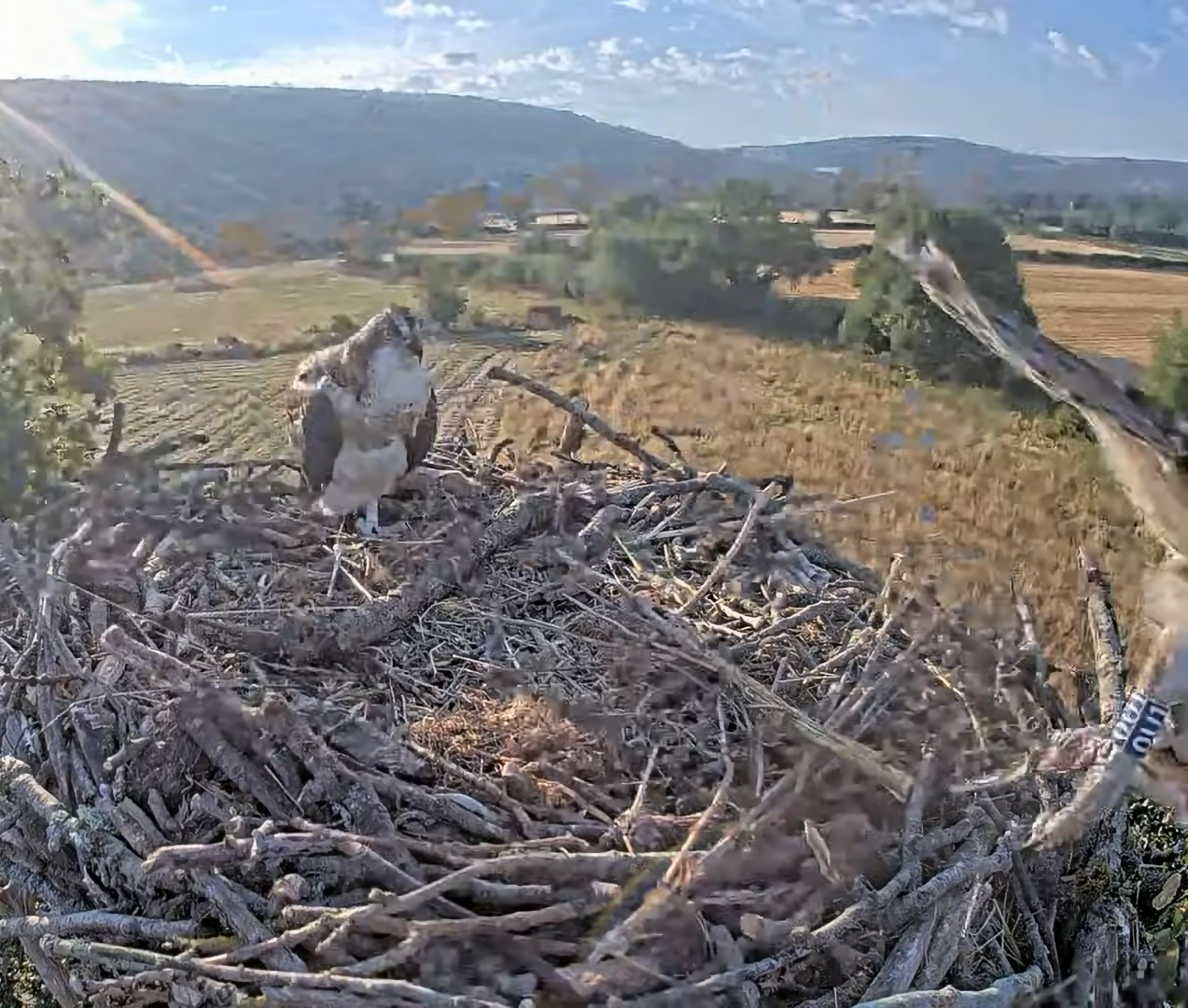
A typical scenario - 0U0 watches dejectedly on as 0U1 departs with food
There have been other subtle changes in observed behaviour as the season inevitably builds up to the eventual migration of all four birds, which is likely to begin in the next three weeks.
Of course, the nest is left vacant for longer periods now, particularly at night. And UVO Field Watchers indicate that new perches have been established so that the young can stay in touch with the nest nearby. A pattern has emerged whereby they can be hidden in the foliage of the ash tree which is 60m from the oak tree nest – their calls can still clearly be heard by the microphones on the nest cameras. Another favourite has become the “Valley Oak” just forward of the “Spinney” which has currently taken over from last year's favourite, the Acorn Perch, within the nest tree itself.

Valley Panorama © Nina Krauzewicz
Another aspect which also aids the Field Watchers is that Clogwyn is clearly replacing a single flight feather, most likely an outer secondary – this makes an easier task of identifying her at distance until the growing feather becomes as long as its companions. The replaced feather may simply have dropped out or been damaged in some way – it is not true moult. Many migrant species, summer visitors especially, reserve moult and feather replacement until a rapid moult after completion of breeding (eg wheatear), or for long-distance migrants such as osprey they wait until they are safely settled into their winter quarters. Completion of any arduous migration journey in autumn would be compromised if feather loss or replacement occurred during it – be it for a short-distance migrant such as a warbler to Iberia, perhaps, or those embarking on 3 – 6000 mile journeys such as osprey or swallows to West or South Africa respectively. Moult of flight feathers occurs mostly in pairs, ie lost or growing feathers as a mirror-image across both wings. Within a fortnight or so Clogwyn’s growing feather will be complete and indistinguishable.

Here the gap in Clogwyn’s left wing feathers is clearly visible
While unlikely that the chicks will have much opportunity for any fishing practice before their long journey south, there are signs of preparation. Common behaviour would be practice-fish-diving – often coming up with just clumps of weeds. There have been no concrete sightings of this behaviour from our chicks but on 2 Aug 0U1 looked suspiciously like there had been some kind of foray into the water with feathers distinctly damp and dishevelled. A matter of conjecture as to the cause but most likely some form of practice-fish-diving.

A damp 0U1
There was a colourful aerial skirmish witnessed between Clogwyn and a visiting osprey intruder on 28 July during which they actually got to lock talons for a second. But there have also been many other species in evidence in and around the nest, may be again a symptom of a changing season. We have witnessed flocks of Canada Geese fly noisily by as they visit to feed on spilt grain in the arable fields. And those inevitable opportunists, carrion crows, were quick to seize upon the often-vacant nest to probe for fish morsels, along with their corvid cousins, the jackdaws. Squirrel, stock dove, pheasant, red kite, buzzards and even an early-morning badger have all been spotted and conjure up a happy biodiverse neighbourhood in which our young osprey family continues to thrive.