
Everything Under the Sun
It would be difficult to report on the past week without reference to the extreme heat where temperature records were broken across the entire UK. So how did this affect life in the nest? Perhaps wildlife has a way of coping with such extremes, even if they are caused by Man. This did seem to be the case for a large part of the week, with Clogwyn performing shielding duties spreading her wings over the chicks to keep the worst of the sun off them. On Wednesday 24 June, a day of peak heat and humidity, Clogwyn was observed “rotating around the nest rim” according to the sun's direction to provide a shield for the chicks. It was also apparent at times that the youngsters were not feeding as voraciously as previously, possibly due to a heat-induced reduced appetite.
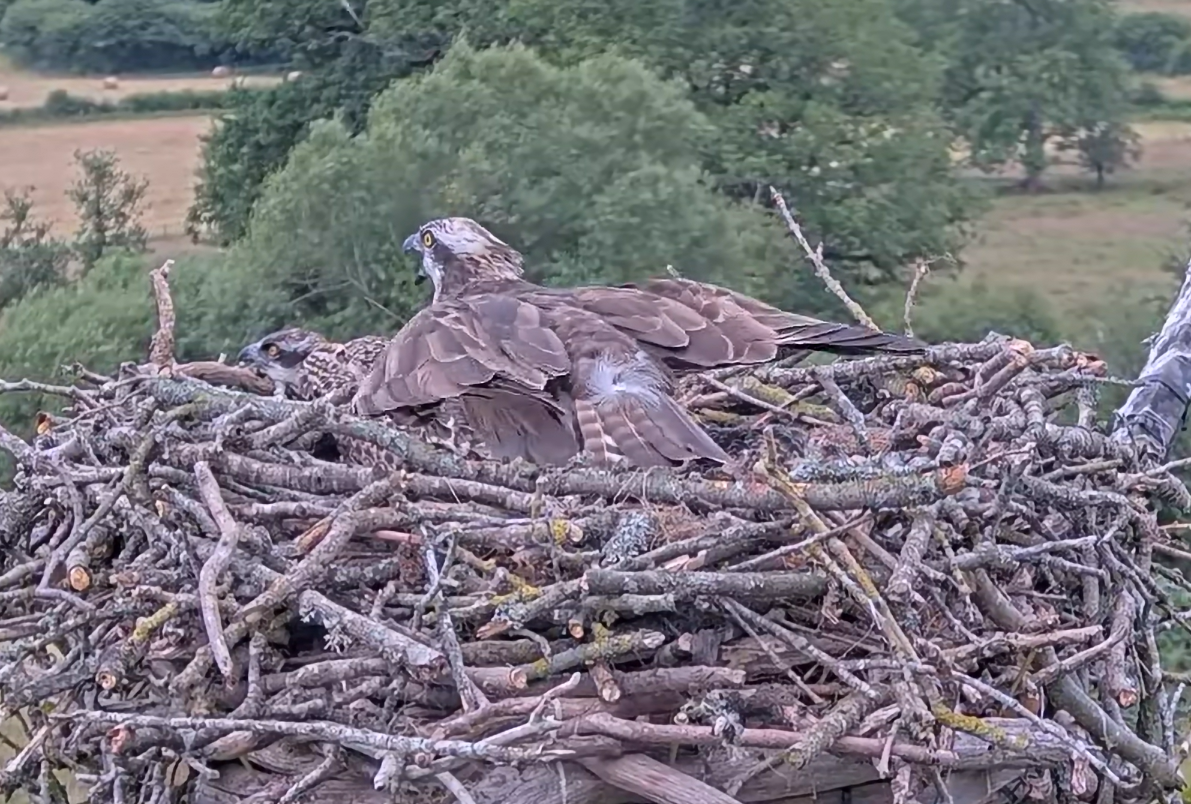
Clogwyn acting as a sun shield for her chicks
In birds, with no equivalent of mammalian sweat glands, one of the main cooling techniques available is ‘gular fluttering’. This is a natural thermo-regulation technique equivalent to panting in mammals. To aid heat loss many species of birds, some more noticeably than others, rapidly vibrate the thin skin and muscles in their throats to increase evaporative cooling across moist membranes. Local curlew and cormorants were also observed using this technique during the past week.
You would think that bodily emissions would be kept to a minimum to conserve fluid levels but on Tuesday 23 June one of the chicks definitely hadn't got that message when it turned its rear end towards the cup camera and fired a bull's eye! Viewing from that camera was effectively out of service until some useful rain came along to clear it at the end of the week.
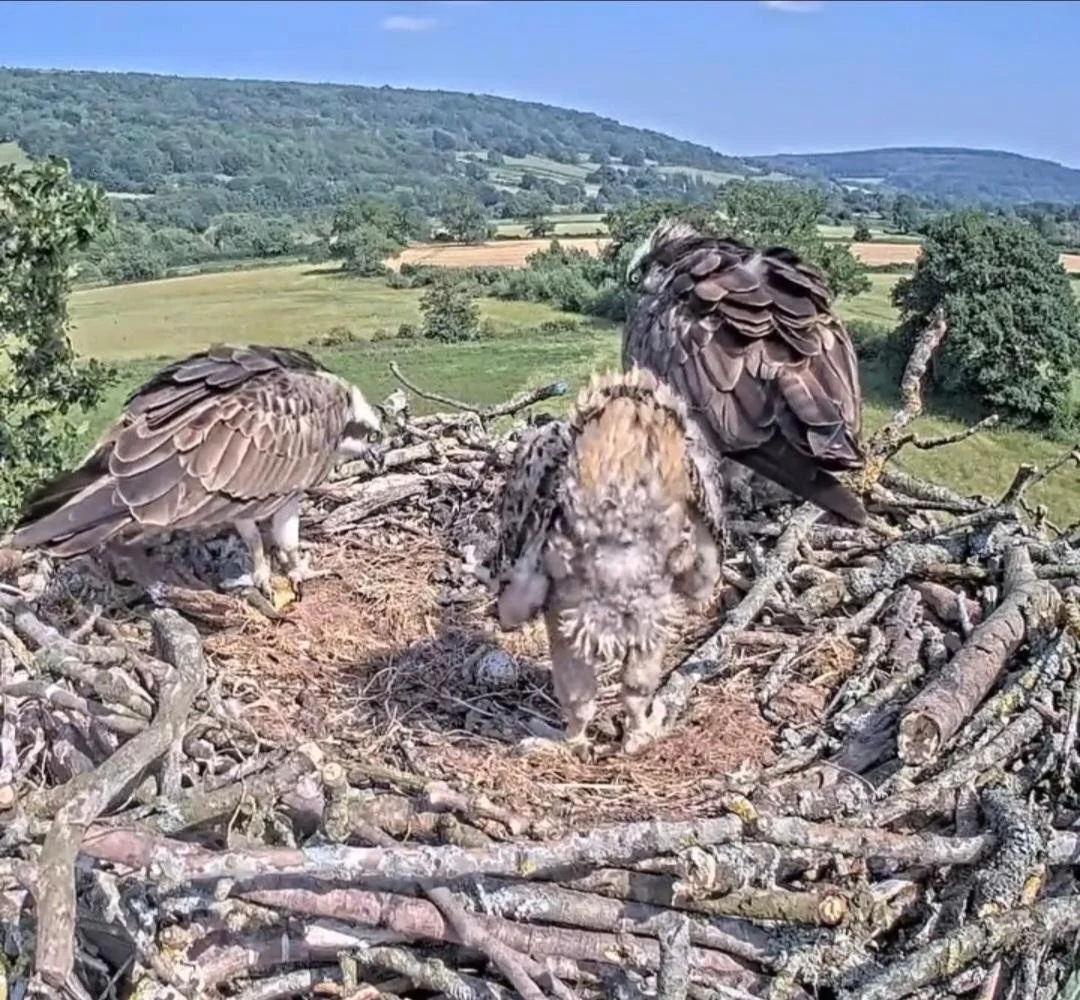
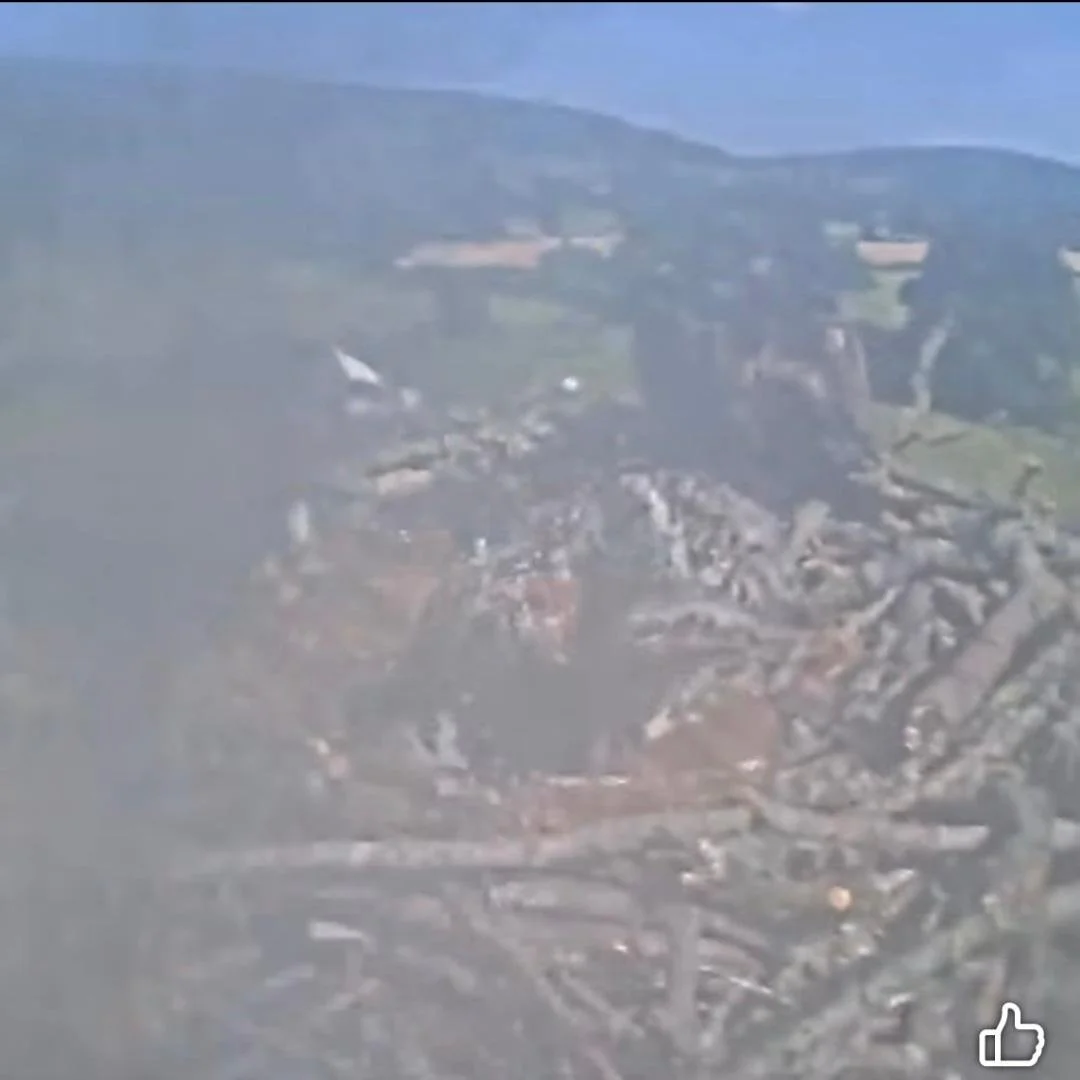
Ready, steady, aim…. Net result
On 28 June a chick was seen to vomit but whether that single event was heat-related or not, it appeared to have no lasting effect.
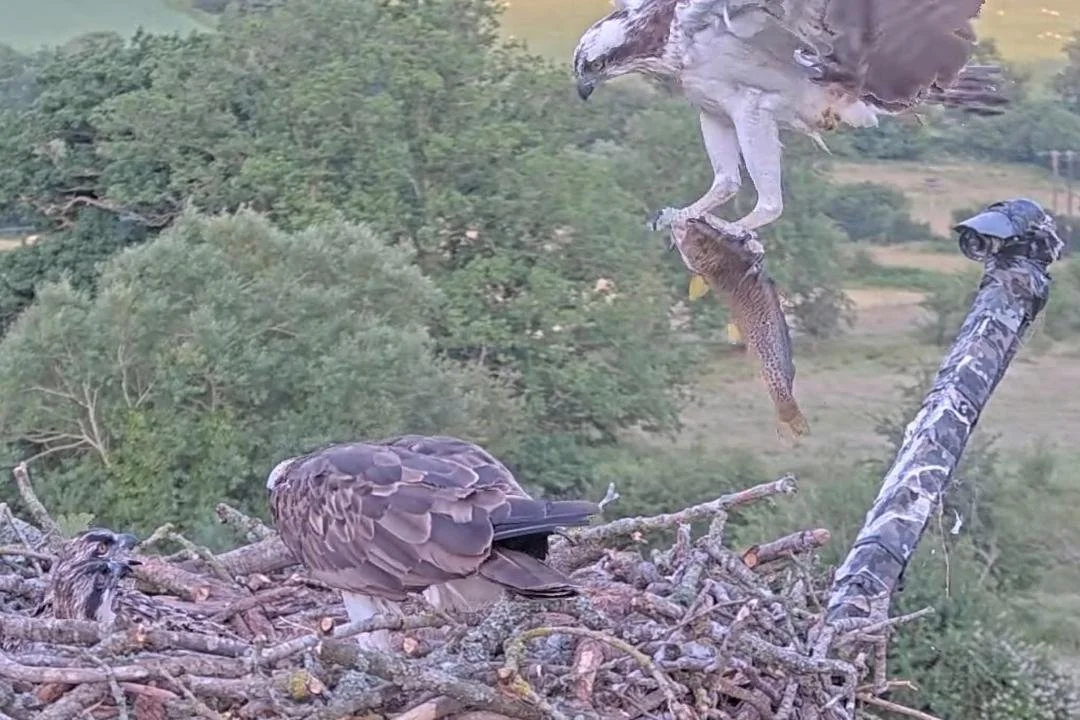
Fish delivery
Fortunately Syfaddan was as reliable as ever in delivering an ample supply of fish to maintain intakes. A wider range of fish species brought in sparked a lively debate amongst camera watchers. Trout – certainly, and also strong candidates for grayling, tench, bream and barbel. On Sunday June 28, one of our roving watchers was thrilled to witness a successful catch when Syfaddan hit the pellucid waters of the Usk River bends. What a spectacle that must have been and on Friday 26th we had what must rate as one of the speediest fish deliveries ever recorded with Syfaddan bringing into the nest a dead fish at 19.51. He left the nest at 19.52 and then reappeared at 19.57 with another dead fish - such is the success rate of this piscivorous hunter.
During this week the nest has not been without its intrusions; on Monday 22 June a squirrel suddenly appeared running up the cup camera pole startling both Syfaddan and Clogwyn as they were calmly going about their nursery duties. On Thursday 25 June at 18.43 a ringed osprey intruder flew by the nest. Its blue Darvic ring could be seen but unfortunately the bird remained too distant for it to be accurately read. Then three days later at around midday another unidentified osprey intruder was seen flying around the valley for some time making circuits in a wide loop around the surrounding area. Twice it broke off from these circuits to hover directly over the nest and on a couple of occasions flew at speed over it. It stayed around for quite some time but eventually disappeared over the ‘Big Bend’, continuing its flight upriver.
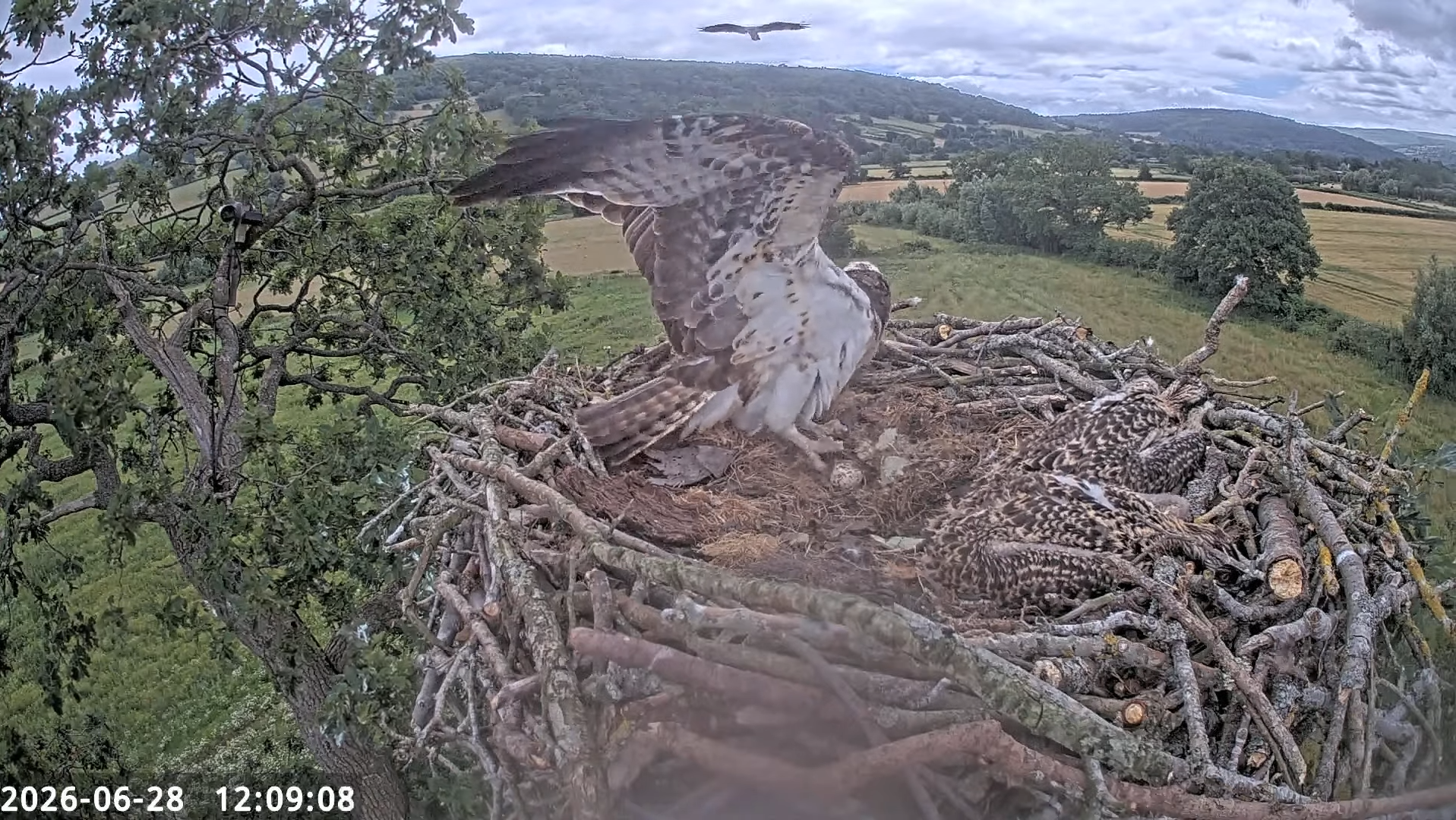
Alarm in the nest at the presence of another intruder
Despite the privations delivered by the heatwave, the chicks are developing well. They are beginning to self-feed and the primary and secondary wing feathers are now growing at pace. Patterning on those feathers, and on the chick’s mantle (= back), show a pale fringe which continues to offer excellent camouflage while they are confined to the nest. Camera watchers have also noted this week that feather growth has had the effect of fading the striking white stripe down the spine of both chicks which strongly resembled the background of dead sticks in the nest. These pale fringes to feathers will persist throughout their juvenile plumage once fledged. The chicks are also now beginning to exercise their wings more vigorously.
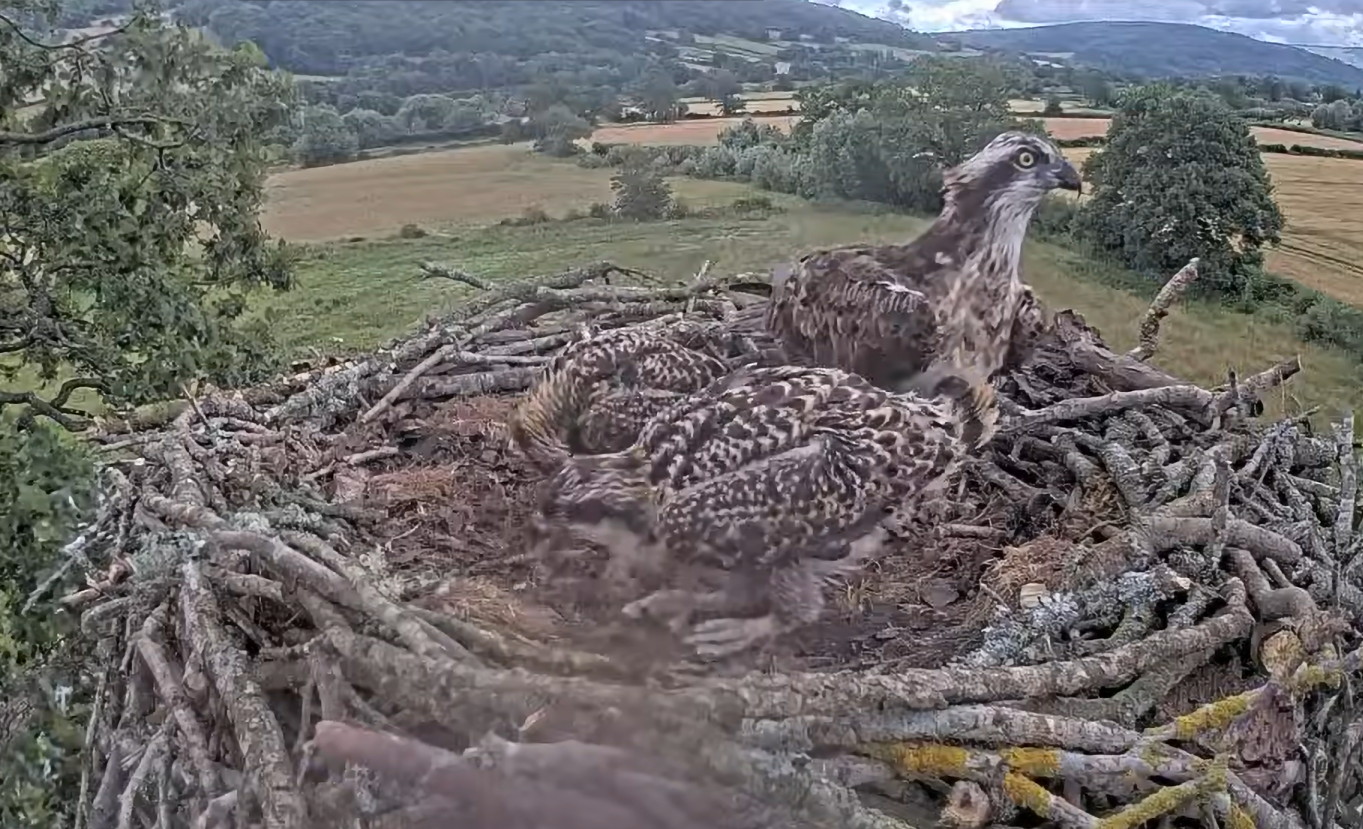
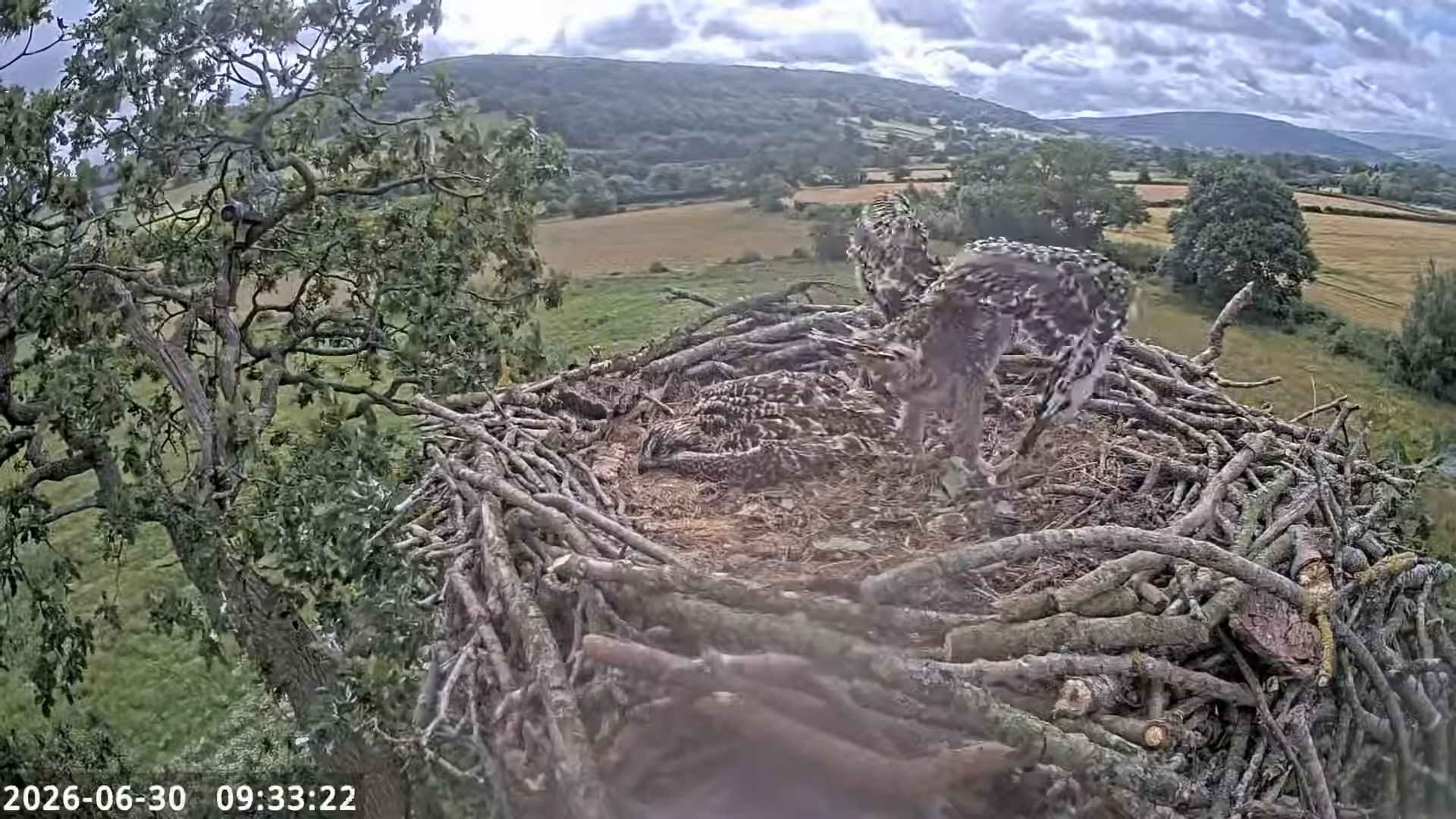
Chick plumage on full display Chick wing flexing
On 23 June one chick was said to be emitting a barking noise. This was deemed to be conversational between the chick and Clogwyn during a 'stick game', which altogether paints a rather happy picture.
Meanwhile, back on earth, life at the viewpoint continued to be busy with an array of visitors eager to catch sight of the birds as they fly in and around the nest. On Thursday 25 June two of the National Grid South Powys team, David Morris and Hannah Davies, braved the heat to check out how well their National Grid Pole installations were being utilised by the ospreys. These key perches are now in regular daily use by the birds and provide an invaluable feature for observing behaviour of the adult pair in the vicinity of the nest. Thanks go to National Grid for this important resource and to their continued interest in Usk Valley ospreys. All the perches are clearly identified on the brand new impressive panoramic 'map' which has recently been installed at the towpath viewpoint for further enjoyment of the visitors.
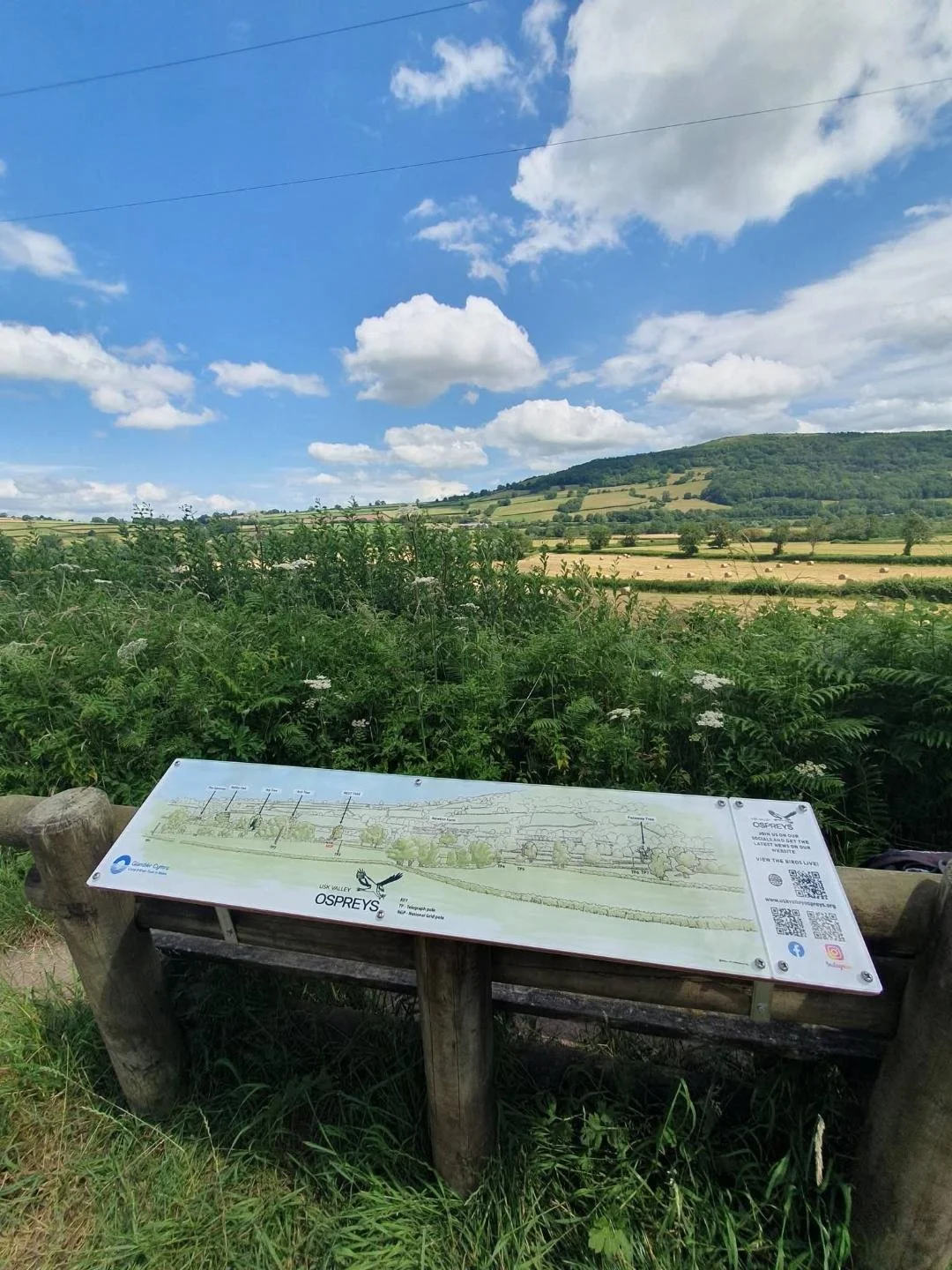
The shiney new panoramic view of the valley