
The expected – and the unexpected
As we have seen over the past four weeks or so our pair of osprey have developed a good routine of incubation, fish delivery and housekeeping. As the weeks progress these have become more polished although both Syfaddan and Clogwyn have the knack of returning to the nest with sticks that by their very shape will be impossible to weave into the nest rim, for example Y-shaped or multi-branched. Other difficult nest-lining materials have been brought in such as fircones and a discarded potplant with peat ball and many side-branches that then proceeded to roll around the nest in an uncontrolled manner.

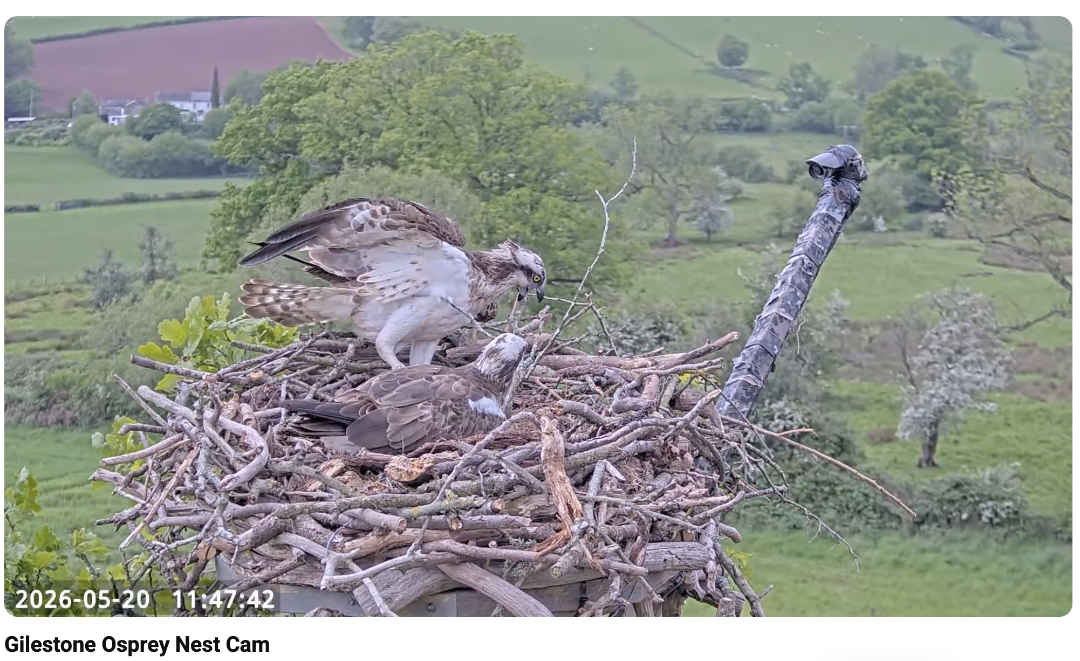
Blue 6J8 Landing - Clogwyn spreads her wings and lies flat to protect the eggs
The pair have also protected their nest by confronting and seeing off several osprey intruders, some of which can only be reported by towpath viewpoint volunteers. The most significant avian intrusion in this period was on 19th May with a brief touch-down on the nest by Blue 6J8, otherwise known as ‘Teddy’, a 2024 female ringed by the Tweed Valley Osprey Project, Peebles. She follows another 2-yr old female from the same Scottish nest and parentage that also visited the Gilestone nest in late-May last year. Recently there has been a strong line in female chicks from that nest which, naturally as returning 2-year olds, tend to roam more widely before later setting up a breeding territory.
The resident pair’s reaction to intruders only confirms they certainly are not invited – equally uninvited were several human intruders into the nest area on the weekend of 9th – 10th May. Even with the pair flying above them and uttering alarm calls they showed a reluctance to leave the nest area. This is the first occasion in three years since the discovery of the nest that the police have been called and attended, and in doing so have led all parties to review their security procedures and adopt new advice from Wildlife Crime police officers. A break in incubation of over an hour is not expected to lead to adverse effects - it does serve, however, as a reminder that measures must be reviewed and tightened on a regular basis. All parties will, of course, be working towards preventing a repeat.
Syfaddan and Clogwyn sharing incubating duties
Even with the occasional distraction the birds continue to settle into a regular routine with incubation duties, especially through the night, falling mostly to Clogwyn, the female. Male Syfaddan is increasing his contributions by relieving his partner shortly after 5am on most mornings. His share of sitting has now reached 6-8 sessions per day (totalling 3-4 hours a 24-hour period) of a duration at each stint spanning 20 – 75 minutes. This is a greater contribution to sharing of incubation than occurred in 2025.
An added value of having volunteers monitoring nest-cam footage and installed at the towpath viewing-point is that wider biodiversity in the valley can continue to be monitored. Even on the basis that there is at least one large bird of prey installed on the nest again in 2026 the bird species list is increasing, most recently through the return of summer migrants such as redstart, tree pipit and spotted flycatcher. At 5.40pm on 16th May Clogwyn went off-duty, left the nest and by doing so flew lower than usual towards a field hedge - she flushed a barn owl from its daytime slumbers. Both birds seemed surprised at each other’s appearance and they went their separate ways.